
Monday, December 12, 2011
The Dead Sea Scrolls
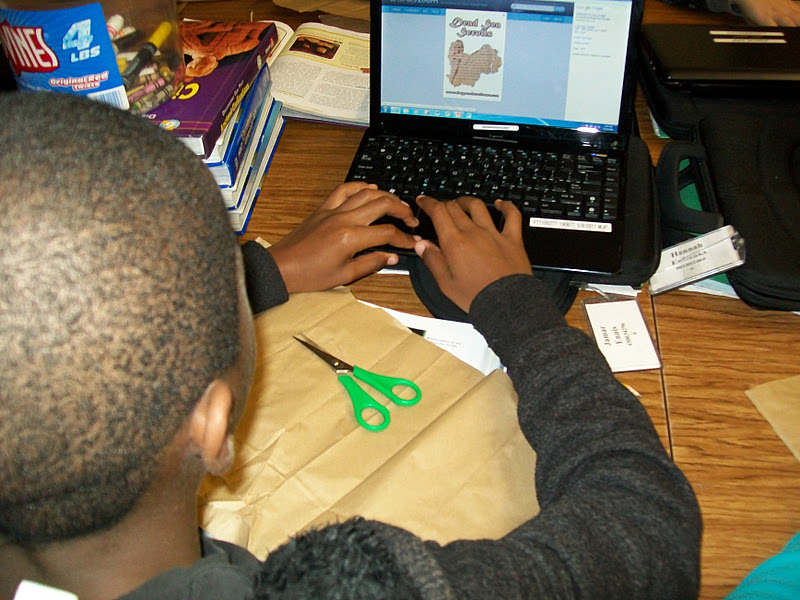
As we investigated standard 6.3.5, we learned that the Dead Sea Scrolls included much insight into the Israelites. Students made their own "Dead Sea Scroll" which included ten important facts we have learned about the Ancient Israelites in the past few weeks. Once students made their scrolls, they took pictures of them and uploaded it into their Ancient Civilizations power point. Well Done Kids!


Thursday, December 8, 2011
First Person Historical Fiction Essay
Today we read out of the Social Studies Text about the "Daily Life of Ancient Israelites" (page 217-218) and took notes. Then we watched s short video of daily life of the Ancient Israelites, then again took notes. Finally we did a web search to learn even more about what life was like for the people of Israel thousands of years ago. Once our notes were complete, students began writing a three or more paragraph essay as if they were an Ancient Israelite. Essays were typed into their Ancient Civalizations Powerpoint, then students recorded themselves reading it and uploaded the recording into a slide as well.
Super job Champion students!
Here is an example of a students essay:
My Life as an Israelite
Shalom! Shalom means hello or peace in Hebrew. Jews have a different language called Hebrew. Do you know how the Israelites used to live? Well you have come to the right person to ask! My name is Athalia which means God is exalted. I am an Israelite. I live with my brother, mother, and father. We live in a mud brick house like the other Jews. In my religion we only believe in one God. My religion effects my whole life. It affects my life with school, clothing, and even food.
My mother taught my brother and I , though when my brother grew old enough our father taught him to earn an income and worship God. Then the elders take over the job so my brother is taught by them. In other words I am only taught by my mother who teaches me to be a good wife, be a good housekeeper, learn about Jewish laws ,about food, and clothing. Girls also learn about courageous ancient Israel women. Boys are very important to a family because they can carry on the family name, and once the father dies can become the head of the family. When a boy reaches the age of thirteen they are considered an adult.
Boys wore turbans, or skull caps on their heads. Girls wore scarfs or skull caps because over their hair because a women's hair was considered very private. Judas wore very lose clothes. Women used flax and wool for clothing , though couldn’t combine any of the materials. What you could eat and couldn’t eat was very strict. We are only allowed to eat certain types of meat for example we are allowed to eat beef and lamb though are restricted to eat pork. We could eat scaly fish though couldn’t eat shellfish or smooth- skinned fish. Matza is a type of flat cracker bread that they ate at every meal. They also ate plenty of fruits and liked barely soup.
The Jewish met on the Sabbath the weekly day of worship and rest. It starts from sundown Friday to sundown Saturday. On this day they would read out of the Tora that later became the first part of the Hebrew Bible . The Hebrew bible is a series of thirty four books put together. The tora describes events in Jewish history. When they read the tora it often rebuilt the Judaism hope during hard times.
One day I got married to a carpenter and all those things I learned came useful. It is like it keeps going at a certain rhythm and never stops. I had kids and taught them exactly how my mother did with me. I hope one day my kids will be as successful as my life has been. In Conclusion I love my life and I wish the best for the Judaism future.
Today
Super job Champion students!
Here is an example of a students essay:
My Life as an Israelite
Shalom! Shalom means hello or peace in Hebrew. Jews have a different language called Hebrew. Do you know how the Israelites used to live? Well you have come to the right person to ask! My name is Athalia which means God is exalted. I am an Israelite. I live with my brother, mother, and father. We live in a mud brick house like the other Jews. In my religion we only believe in one God. My religion effects my whole life. It affects my life with school, clothing, and even food.
My mother taught my brother and I , though when my brother grew old enough our father taught him to earn an income and worship God. Then the elders take over the job so my brother is taught by them. In other words I am only taught by my mother who teaches me to be a good wife, be a good housekeeper, learn about Jewish laws ,about food, and clothing. Girls also learn about courageous ancient Israel women. Boys are very important to a family because they can carry on the family name, and once the father dies can become the head of the family. When a boy reaches the age of thirteen they are considered an adult.
Boys wore turbans, or skull caps on their heads. Girls wore scarfs or skull caps because over their hair because a women's hair was considered very private. Judas wore very lose clothes. Women used flax and wool for clothing , though couldn’t combine any of the materials. What you could eat and couldn’t eat was very strict. We are only allowed to eat certain types of meat for example we are allowed to eat beef and lamb though are restricted to eat pork. We could eat scaly fish though couldn’t eat shellfish or smooth- skinned fish. Matza is a type of flat cracker bread that they ate at every meal. They also ate plenty of fruits and liked barely soup.
The Jewish met on the Sabbath the weekly day of worship and rest. It starts from sundown Friday to sundown Saturday. On this day they would read out of the Tora that later became the first part of the Hebrew Bible . The Hebrew bible is a series of thirty four books put together. The tora describes events in Jewish history. When they read the tora it often rebuilt the Judaism hope during hard times.
One day I got married to a carpenter and all those things I learned came useful. It is like it keeps going at a certain rhythm and never stops. I had kids and taught them exactly how my mother did with me. I hope one day my kids will be as successful as my life has been. In Conclusion I love my life and I wish the best for the Judaism future.
Today
Wednesday, December 7, 2011
Learning In Teams
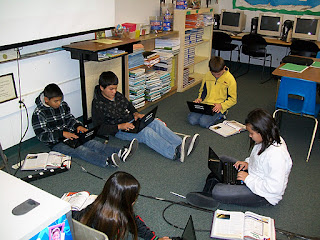
Students were able to work in teams and investigate standards based questions about Ancient Israelites (st. 6.3). Students were put in groups of five and asked to research five topics and take notes to add to their Ancient Civilization powerpoint. Group work with middle school kids can get hectic, but these students did a great job working together similar to a college class.



Tuesday, December 6, 2011
Ancient Israelites
Today we focused on standard 6.3.3 The people of Ancient Israel. We researched and read about the important people, then students chose one to write a short poem/ song about. Once that was created on their Ancient Civilizations power point, students went to VirtualKeyboard.com and made it into a song. Once they recoded their song, it was uploaded into their slide.
Getting notes and summarizing into our own words
 After writing the song/ poem, making the music...


Getting notes and summarizing into our own words


Monday, December 5, 2011
Reading Activity
We read the story Eleven, by Sandra Cisneros. Then students were placed in teams of five to play an interactive game called, "Numbered Heads Together". I used quarter 2 standard questions that related to the story Eleven and each team came up with their own answers. Then we used the electronic spinner to see who would answer the questions for their team.
After the game, students wrote a response to Literature using insight into the characters. Once their essays were completed, they posted them on a message board in Thinkquest for the class to read.
This is what the game looks like....

Students working in teams answering their questions
 Students working in teams
 This board posts the game and questions...
 Example of a students essay:
After the game, students wrote a response to Literature using insight into the characters. Once their essays were completed, they posted them on a message board in Thinkquest for the class to read.
This is what the game looks like....

Students working in teams answering their questions


 Courtney C
Response to Literature- Eleven
Do you like your birthdays, getting presents and being with family? In the story Eleven, By Sandra Cisneros we learn that a girl named Rachel isn’t being understood by her unreasonable teacher. The theme of the story is even though we are a certain age; we can morph into whatever age fits our emotions best. The story is good because it tells of a life lesson that should be known by all.
The main character in the story is Rachel. One word to describe her is frustrated, for example on Pg. 365 she thinks in her head “Not Mine, Not Mine, Not Mine” when Mrs. Price is telling her that the ugly red sweater is hers. This shows that she is annoyed because her teacher isn’t listening to her. Another word to describe her is Unhappy, for example on Pg. 366, “I’m crying in front of everyone”, this shows that she is embarrassed to be acting like a three year old. And a final word to describe Rachel is Many Ages, for example on Pg. 365 “What they don’t tell you about being eleven is that your also ten, nine, eight, seven, six, five, four, three, two, and one.”, this shows that even though you are eleven you don’t always have to act eleven.
Another character in the story is Mrs. Price. One word to describe her is mean, for example on Pg. 366, “You put that sweater on right now!” this shows that she isn’t very good at listening. Another word to describe her is rude, for example on Pg. 366 “Mrs. Price pretends like everything is OK” this shows that she doesn’t want to believe that she is wrong and somebody else is right. A final word to describe Mrs. Price is unreasonable, for example on Pg. 366 “Mrs. Price says ‘Now Rachel that’s enough!” this shows that she just can’t wrap her head around that sweater not being Rachel’s.
In conclusion, the story Eleven by Sandra Cisneros is interesting because of the way she talks about the way we have all different ages and emotions inside of us.
Today
Story Bird Work
We will be walking over to E.P. Foster school to read the stories to the primary students on Tuesday Dec. 13th. Students wrote original stories just for the E.P. Foster students.
Here is one example of an amazing story.... (these are uploaded onto Thinkquest.org if you would like to see more..


Friday, December 2, 2011
Self and Peer Editing of our Storybird Book
Writing a story is a process, and now we are editing our work using a rubric/ checklist as our guide.
Today students finished their stories, wrote an "All about the Author" page, then edited and peer edited the stories. Next the stories were uploaded onto Thinkquest for all the class to read. Next week we will be reading them to the Kindergartners!


Today students finished their stories, wrote an "All about the Author" page, then edited and peer edited the stories. Next the stories were uploaded onto Thinkquest for all the class to read. Next week we will be reading them to the Kindergartners!


Subscribe to:
Posts (Atom)